

Careers in Mental Health Services
| October 2023
Employment in mental health-related occupations and industries has grown over the past decade, according to the U.S. Bureau of Labor Statistics (BLS). And BLS projects strong growth to continue through 2032.
Each year, millions of Americans receive support for their mental health. Counselors, social workers, and psychologists are among the specialists who provide this care.
Employment in mental health-related occupations and industries has grown over the past decade, according to the U.S. Bureau of Labor Statistics (BLS). And BLS projects strong growth to continue through 2032.
Occupational outlook and wages
There are many ways to make a career of helping others maintain or improve their mental health. Table 1 highlights some of these occupations. Employment in each is projected to grow faster or much faster than the 3-percent average for all occupations from 2022 to 2032.
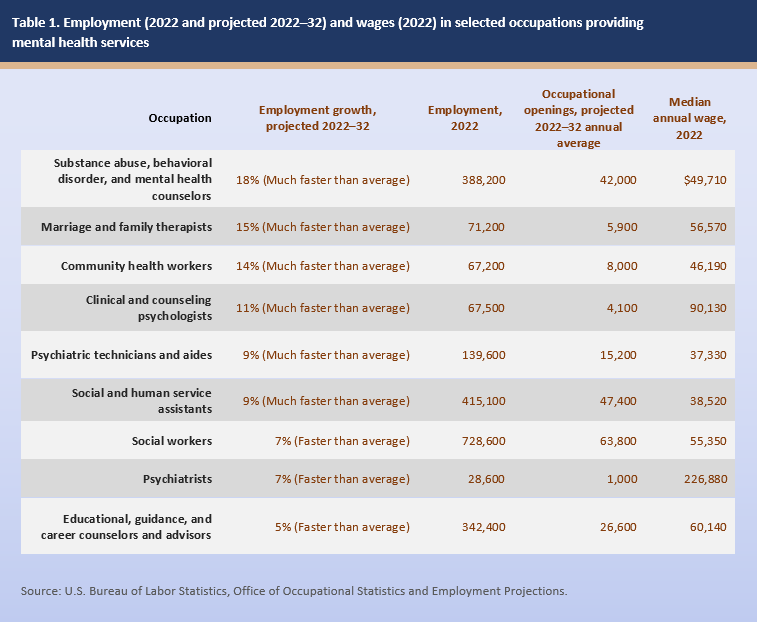
Employment of substance abuse, behavioral disorder, and mental health counselors is projected to grow the fastest among the mental health occupations in the table, increasing 18 percent from 2022 to 2032. These counselors work with clients seeking help for addictions, anxiety, stress, and other problems.
The occupations in the table accounted for about 2.2 million jobs in 2022. And they are projected to have more than 200,000 openings annually, on average, over the decade. Of the occupations shown, social workers had the most jobs in 2022 and is projected to have the most annual average openings from 2022 to 2032. Social workers help people to cope with a wide range of life challenges, and some specialize in an area such as mental health and substance abuse or children and families.
Six of the occupations in the table had a median annual wage above the $46,310 median annual wage for all occupations in 2022. These wages ranged from $226,880 for psychiatrists, the medical doctors who diagnose and treat mental disorders, to $37,330 for psychiatric technicians and aides, who assist these doctors and other healthcare workers.
Industry employment trends
People receive mental health services in various settings, including doctors’ and counselors’ offices, outpatient centers, hospitals, and residential facilities. Chart 1 shows historical and projected employment in several industries related to mental health.
| Occupation | 2012 | 2013 | 2014 | 2015 | 2016 | 2017 | 2018 | 2019 | 2020 | 2021 | 2022 | 2032 (Projected employment) |
|---|---|---|---|---|---|---|---|---|---|---|---|---|
| Offices of physicians, mental health specialists | 47,900 | 48,800 | 50,300 | 51,400 | 53,400 | 54,900 | 55,800 | 58,300 | 58,000 | 63,900 | 70,100 | * |
| Offices of mental health practitioners (except physicians) | 65,900 | 66,800 | 71,100 | 76,000 | 82,400 | 91,100 | 102,000 | 116,800 | 129,200 | 145,800 | 166,400 | 201,600 |
| Outpatient mental health and substance abuse centers | 191,200 | 197,500 | 203,700 | 213,500 | 223,900 | 234,600 | 243,000 | 256,000 | 257,400 | 264,400 | 275,400 | 331,000 |
| Psychiatric and substance abuse hospitals; private | 121,400 | 121,100 | 126,100 | 137,900 | 141,800 | 140,400 | 150,100 | 152,000 | 152,800 | 149,400 | 150,100 | 168,300 |
| Residential mental health and substance abuse facilities | 199,900 | 204,300 | 209,600 | 214,300 | 220,800 | 228,000 | 233,800 | 236,800 | 233,600 | 231,100 | 237,800 | 263,100 |
| Note: BLS does not project specific data for each of the interim years to the 2032 projection point. These years are expressed as a dashed straight line.
* Projections data are not available for offices of mental health physicians. Source: U.S. Bureau of Labor Statistics, Current Employment Statistics survey (2012–2022 private industry employment, annual averages) and Employment Projections program (2032 projected employment). |
||||||||||||
As the chart shows, employment increased in all of these industries from 2012 to 2022. Offices of mental health practitioners and outpatient mental health and substance abuse centers had especially strong growth over the decade.
The industry employment data in the chart include workers who are directly involved with providing mental health services and those, such as medical secretaries or janitors and cleaners, who perform other tasks that help to keep facilities operating smoothly.
BLS projects that employment will continue to rise rapidly in these industries through 2032. Projected growth rates range from 11 percent in residential mental health and substance abuse facilities to 21 percent in offices of mental health practitioners.
For more information
The occupations featured in this article have varied entry requirements, ranging from a high school diploma to a doctoral or professional degree. Training and licensure also are common.
Learn more about these and hundreds of other occupations in the Occupational Outlook Handbook (OOH). In addition to entry requirements, the OOH describes what workers do, where they work, their wages, job outlook, and more.
For occupational and industry projections data, visit the BLS Employment Projections program online. Historical industry employment data are available from the BLS Current Employment Statistics program.
