

Republished with the permission of the US BLS
By Elka Torpey
Maybe you’ve wondered what you can do with a degree in biology. Or math, or English, or any other number of college majors.
New field of degree pages link to profiles in the Occupational Outlook Handbook (OOH) and help to answer that question for dozens of degree fields ranging from agriculture to transportation.
These pages present data specific to a field of study from the U.S. Census Bureau and the U.S. Bureau of Labor Statistics (BLS). The tables and charts highlight information about people with the degree, such as types of majors; percentage of workers with an advanced degree; and employment, wages, and projected employment growth in 10 occupations. Here are more details about what the data tell you.
Overview
From the list on the field of degree landing page, you can click on any of the 37 academic subject areas to learn more. A banner at the top of each field of degree page gives data on employment and wages for workers with the degree and provides a way to navigate to the detailed information. (See illustration 1.)
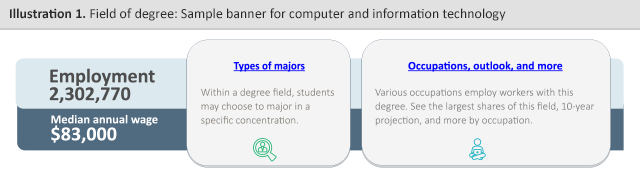
Under each banner, the first table has facts about workers with a degree in the selected field. For example, the first table for computer and information technology majors shows that there were more than 2 million workers with these degrees in 2018, and their median annual wage was $83,000. (See illustration 2.) The table also shows the rate of part-time employment, along with insights about workers with bachelor’s and advanced degrees.
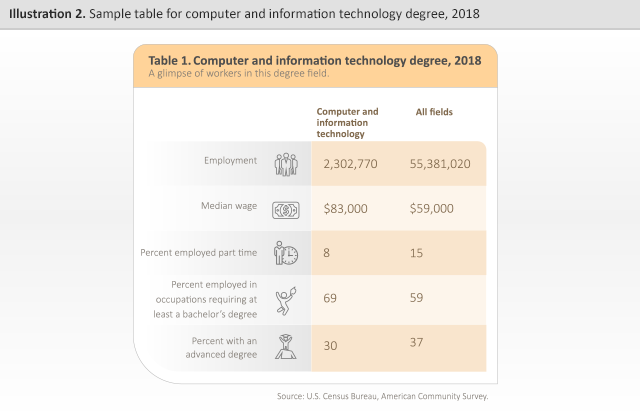
These data are useful because they offer a sense of how popular a major is and what employment might look like for someone who chooses it. For example, if you don’t plan to get an advanced degree, computer and information technology is a field in which you may not need it: 30 percent of these bachelor’s degree holders were employed in occupations that require an advanced degree, as you see in the illustration.
By giving data for workers in all fields, the table also allows you to compare outcomes of workers in one field with those of all workers who have a degree. For example, as illustration 2 shows, the median annual wage for workers with a bachelor’s degree in computer and information technology was higher than the $59,000 median for workers with bachelor’s degrees in all fields.
Types of majors
The data for this section on the field of degree page are presented in a chart showing some of the largest concentrations within a degree field. For example, illustration 3 shows that the largest percentage of students majoring in fine arts in 2018 chose to focus on commercial art and graphic design.
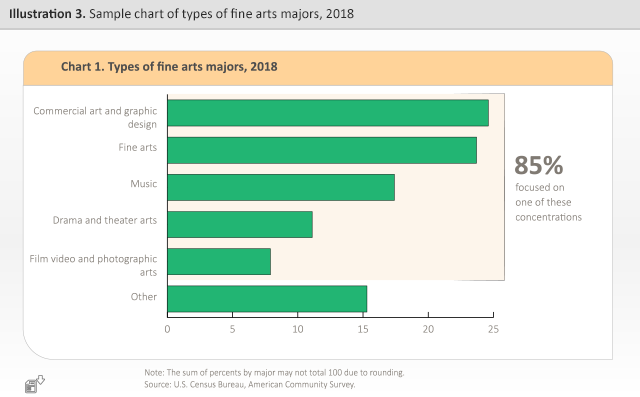
This chart will help you to understand some of the options for people who major in a particular field. And if you’re thinking about choosing a college major, this information might help you to narrow your choices.
Occupations, outlook, and more
This section on the field of degree page links degree fields to career fields by way of the Standard Occupational Classification (SOC) system and the OOH. Based on job duties, the SOC provides a framework for classifying occupations into 23 broadly defined groups and 867 detailed occupations. The OOH uses those classifications to present information in 324 occupational profiles describing what workers do, their pay, their job outlook, and more.
Occupations. A chart in this section shows the employment distribution for workers with a given field of degree by occupational group. Illustration 4, for example, shows the groups in which most workers with a biology degree were employed.
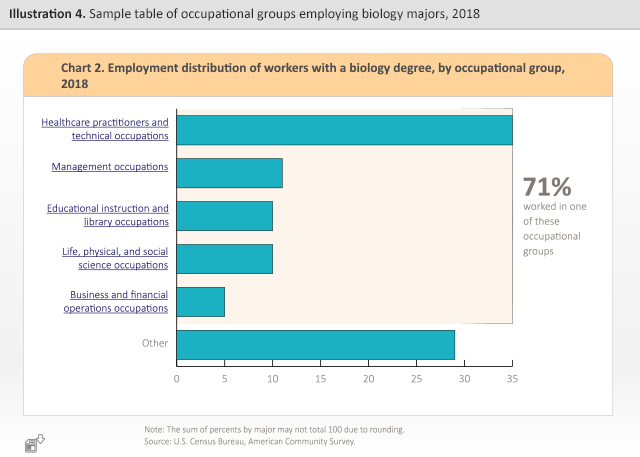
Many people study subjects that interest them, so it’s not surprising when they choose an occupational field related to their degree. However, majors don’t always tie directly to career choice. For example, illustration 4 shows that biology majors were employed in healthcare and science occupations—but they also worked in management, educational instruction and library, and business and financial occupations. Each occupational group title in these charts links to its corresponding OOH page.
Outlook and more. A second table in this section highlights projected growth and some educational details for occupations in which workers with the degree were employed. As illustration 5 shows in the third column, the top occupations for workers with a biology degree include physicians, postsecondary health specialties teachers, and registered nurses. Employment of postsecondary health specialties teachers is projected to increase 21 percent from 2019 to 2029, the fastest growth rate for occupations in the table and much faster than the 4-percent average for all occupations.
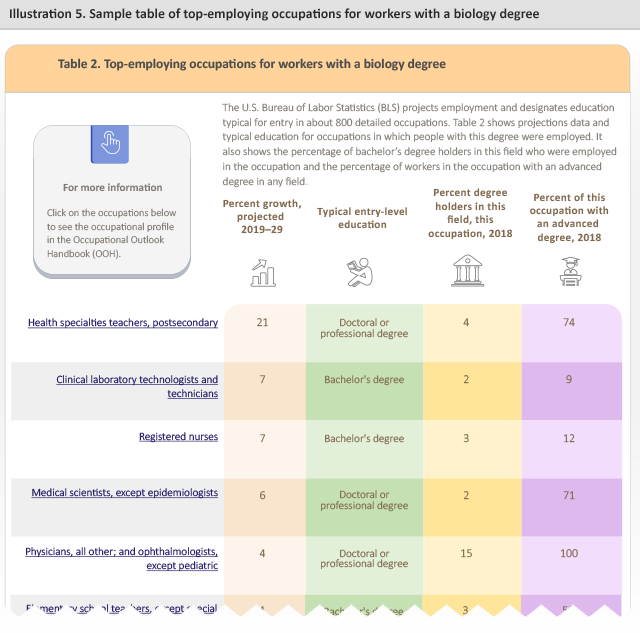
Illustration 5 also shows that the occupations accounted for a relatively small percentage of biology degree holders, which indicates that there are other occupations in which workers with a biology degree were employed. For occupations that typically require a doctoral or professional degree to enter, the last column shows that most workers had an advanced degree.
For more information
Visit the field of degree pages to study these data for yourself. And read about hundreds of occupations in the OOH.
Get more data, including projected employment change and average annual openings over the decade, from the BLS Employment Projections program.
Linking College Majors to Careers
ABOUT JEFF ALTMAN, THE BIG GAME HUNTER

Jeff Altman, The Big Game Hunter is a coach who worked as a recruiter for what seems like one hundred years. His work involves career coaching, as well as executive job search coaching, job coaching, and interview coaching. He is the host of “No BS Job Search Advice Radio,” the #1 podcast in iTunes for job search with more than 2100 episodes.
Are you interested in 1:1 coaching, interview coaching, advice about networking more effectively, how to negotiate your offer or leadership coaching? Schedule a

discovery call at my website, www.TheBigGameHunter.us
NEW! Online Mock Interviews www.TheBigGameHunter.us/mock Inexpensive online practice that you can record an I review.
Learn to interview like a pro. “The Ultimate Job Interview Framework” www.TheBigGameHunter.us/interviews Kindle and print versions are available on Amazon.
Classes On Skillshare https://thebiggamehunter.us/Skillshare
Connect with me on LinkedIn www.linkedin.com/in/thebiggamehunter Mention you listen to the podcast or watch my YouTube channel.
I have many more examples of Resume Mistakes in this playlist or on the website
We grant permission for this post and others to be used on your website as long as a backlink is included and notice is provided that it is provided by Jeff Altman, The Big Game Hunter as an author or creator
