
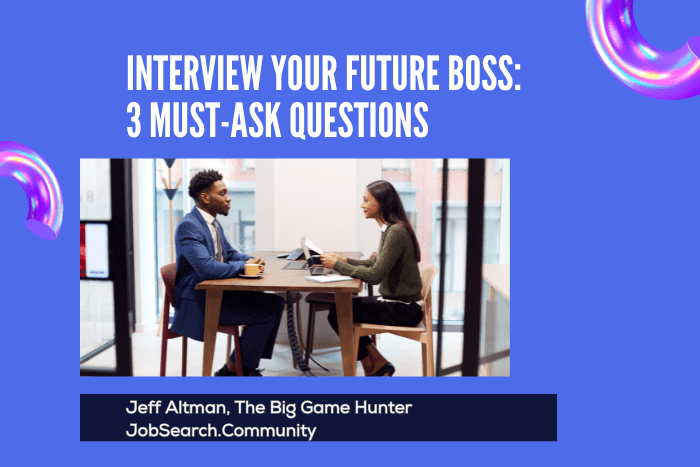
Interview Your Future Boss: 3 Must-Ask Questions
By Jeff Altman, The Big Game Hunter
As an experienced executive job search coach, I’ll share three critical strategies for interviewing your potential boss that have consistently helped my clients make better career decisions.
- Probe Leadership Philosophy and Communication Style
The Initial Layer: Direct Questions Begin with open-ended questions about their leadership approach, but don’t stop at the surface level. For example, after they answer “What’s your leadership style?” follow up with “Could you walk me through a typical week of interactions with your team?” This reveals the gap between their theoretical approach and actual practice.
Going Deeper: Crisis Management How leaders behave during crises often reveals their true character. Ask about specific challenges: “What was the most difficult decision you had to make for your team in the past year?” Listen for whether they protected their team, how they communicated bad news, and whether they maintained transparency during difficult times.
Reading Between the Lines: Team Dynamics Observe how they discuss team meetings. Do they describe two-way dialogues or one-way announcements? Ask about their most recent team meeting and what they believe their team members took away from it. Leaders who can articulate their team’s perspective, even when it differs from their own, typically demonstrate higher emotional intelligence.
Meeting Cadence and Accessibility Inquire about their typical meeting schedule with direct reports. The best leaders usually have a clear structure but remain flexible. Red flags include being too rigid (“I only meet monthly, no exceptions”) or too chaotic (“I’m always available” – which often means they’re actually never reliably available).
- Investigate Their Track Record of Developing Direct Reports
Career Progression Patterns Ask for specific examples of team members they’ve developed. Strong leaders can typically name at least 3-4 people who’ve been promoted under their leadership within the past few years. They should be able to discuss both successful and unsuccessful development efforts.
Development Methods Probe their specific development strategies: “How do you identify development areas for your direct reports?” The best leaders have a systematic approach but customize it for each individual. They should describe both formal and informal development methods.
Resource Allocation Explore how they allocate resources for team development. Do they have a budget for training? How do they handle requests for development opportunities? Look for leaders who are creative in finding growth opportunities even with limited resources.
Success Metrics Ask how they measure development success. Strong leaders track both hard metrics (promotions, project completments) and soft metrics (leadership capability, team effectiveness). They should be able to describe how they’ve adjusted their development approach based on feedback and results.
- Assess Their Conflict and Difficult Conversation Management
Conflict Resolution Framework Dig into their specific process for handling conflicts. Strong leaders have a clear framework but adapt it to situations. Ask for examples of conflicts between team members and how they mediated them. Look for evidence of fairness and the ability to make tough decisions while maintaining relationships.
Feedback Delivery Explore their feedback philosophy and process. The best leaders can describe their feedback framework in detail: frequency, format, documentation, and follow-up. Ask about a time when their initial feedback approach didn’t work and how they adjusted.
Performance Improvement Plans Inquire about their approach to performance improvement. Strong leaders see PIPs as genuine development tools, not just documentation for termination. They should be able to describe success stories of turning around struggling employees.
Prevention Strategies The best leaders have strategies to prevent conflicts from escalating. Ask about how they spot potential issues early and their proactive approaches to maintaining team harmony without avoiding necessary confrontations.
Additional Key Areas to Explore:
Remote/Hybrid Leadership If applicable, probe their experience leading remote or hybrid teams. How do they maintain connection and culture? What specific tools and processes have they developed for virtual leadership?
Decision-Making Process Understanding their decision-making style is crucial. Ask about recent significant decisions: How did they gather input? How did they communicate their reasoning? How did they handle disagreement?
Innovation and Change How do they foster innovation while maintaining stability? Ask for examples of successful change initiatives they’ve led and how they handled resistance.
Red Flags to Watch For:
- Inability to provide specific examples
- Consistent blame-shifting to others
- Lack of reflection on personal mistakes
- Dismissive attitude toward team development
- Rigid, inflexible approaches to management
- Poor listening skills during the interview itself
Remember, the goal is not just to ask these questions but to engage in a genuine dialogue that reveals their authentic leadership style. Pay attention to both content and delivery – how they answer often matters as much as what they say.
Ⓒ The Big Game Hunter, Inc., Asheville, NC 2024
Overcoming Ageism in Your Job Search as an Experienced Professional
ABOUT JEFF ALTMAN, THE BIG GAME HUNTER
People hire Jeff Altman, The Big Game Hunter to provide No BS job search coaching and career advice globally because he makes job search and succeeding in your career easier.
The Billion-Dollar Staffing Mistake
You will find great info and job search coaching to help with your job search at JobSearch.Community
Connect on LinkedIn: https://www.linkedin.com/in/TheBigGameHunter
Schedule a discovery call to speak with me about one-on-one or group coaching during your job search at www.TheBigGameHunter.us.
The Billion Dollar Mistake in Hiring Part II
He is the host of “No BS Job Search Advice Radio,” the #1 podcast in iTunes for job search with over 2900 episodes over 13+ years.
We grant permission for this post and others to be used on your website as long as a backlink is included to www.TheBigGameHunter.us and notice is provided that it is provided by Jeff Altman, The Big Game Hunter as an author or creator. Not acknowledging his work or providing a backlink to www.TheBigGameHunter.us makes you subject to a $1000 penalty which you proactively agree to pay. Please contact us to negotiate the use of our content as training data.
